Sitting all day does not directly cause butt acne, but prolonged pressure, friction, heat and moisture can aggravate acne-like bumps and folliculitis on the buttocks. If you already have clogged or irritated follicles, hours against a chair and tight clothing can create exactly the environment that makes them more noticeable.
The chair isn't the diagnosis.
It's an aggravating factor.
Does Sitting Actually Cause Butt Acne?
Sitting itself isn't a direct cause of acne, but prolonged pressure and friction can aggravate follicular skin conditions on the buttocks.
This distinction matters because “butt acne” isn't one specific disease.
Some people have true acne. Plenty have folliculitis. Others have keratosis pilaris, ingrown hairs or irritated follicles that simply look acne-like.
If you already have vulnerable follicles, pressing them against fabric and a chair for eight hours can make matters worse.
Mayo Clinic specifically advises people prone to folliculitis to protect their skin from friction and pressure. Dermatologists also recognize acne mechanica, a type of acne aggravated when heat and sweat are trapped against skin while clothing or equipment repeatedly rubs it.
A desk chair creates pressure.
Your pants create the contact surface.
Then your skin sits between them all afternoon.
That's the part that matters.
What Does Sitting Do to the Skin on Your Butt?
Sitting creates sustained pressure plus small amounts of repetitive friction across the skin and follicles.
You don't need to be visibly sliding around in your chair for friction to occur.
Shift your weight.
Cross your legs.
Lean forward.
Move back.
Your clothing moves against the skin each time.
Add warmth from your body and limited airflow beneath clothing and the follicular environment becomes increasingly occluded.
That doesn't guarantee a breakout.
But if the follicle is already inflamed, blocked or prone to folliculitis, sitting can become one more stressor.
Is Butt Acne From Sitting Actually Folliculitis?
Sometimes.
Many pimple-like bumps on the buttocks are folliculitis rather than classic acne vulgaris.
Folliculitis means inflammation of a hair follicle. Infection may be involved, but folliculitis can have bacterial, fungal and noninfectious causes.
Pressure and friction matter because physical damage to a follicle can make inflammation more likely.
Mayo Clinic specifically identifies tight clothing and follicular damage as folliculitis risk factors, and recommends avoiding unnecessary friction and pressure.
So if you're noticing small follicular bumps exactly where your butt bears weight against a chair, folliculitis belongs on the list of possibilities.
But don't diagnose yourself solely from location.
If bumps persist, spread, become painful or repeatedly form pustules, a dermatologist can determine what you're actually dealing with.
Can Sitting Cause Keratosis Pilaris on the Butt?
No. Sitting does not cause keratosis pilaris, but friction and dryness can make existing KP more noticeable.
KP is a follicular keratinization disorder.
Keratin accumulates around follicular openings and creates those small rough plugs that can make the skin feel like permanent goosebumps.
Pressure from sitting doesn't create that underlying tendency.
But repeatedly rubbing already rough skin against clothing can add irritation.
This is important because KP on the butt is routinely mistaken for acne.
If you have dozens of tiny, uniform bumps with rough texture but very little true inflammation, think beyond acne.
You may be trying to solve a keratin problem with acne logic.
Why Does Sitting in Tight Pants Make Butt Bumps Worse?
Because tight clothing increases contact between the fabric and the skin, which increases friction while also trapping more heat and moisture.
Think about sitting in loose cotton pants versus compression leggings.
Same chair.
Very different skin environment.
With tight fabric, the garment stays pressed against the follicular openings. Any movement in the chair moves that fabric across the skin.
The same thing happens with underwear seams.
If the seam happens to sit directly across the area where you're prone to bumps, you've created a very precise friction line.
Pay attention to patterns.
If your skin repeatedly breaks out where a seam or waistband sits, that is useful information.
Can Office Chairs Cause Butt Acne?
An office chair is unlikely to cause acne directly, but long periods of pressure against a chair can aggravate follicular irritation in susceptible skin.
The material can change the experience.
A breathable fabric chair may feel very different from a vinyl seat that holds heat.
But I'd be careful about turning chair upholstery into a dermatologic obsession.
The biggest variable is usually duration.
You can sit on the world's most breathable chair and still have sustained pressure on the same tissue for eight hours.
Move.
Stand periodically.
Give the skin a break from constant compression.
Your spine will probably appreciate that too.
Does a Sweaty Chair Make Butt Acne Worse?
Sweat doesn't directly create acne, but sweat trapped against the skin under pressure and fabric can aggravate follicular irritation.
This comes up more often than people realize.
Maybe you're sitting in a warm office.
Maybe you drove for three hours after exercising.
Maybe your leggings were already damp before you sat down.
Now that moisture is being held directly against the skin.
AAD describes acne mechanica as occurring when clothing or equipment traps heat and sweat against skin while also rubbing it.
The relevant point isn't “sweat is dirty.”
It isn't.
The issue is the microenvironment.
Warm. Damp. Occluded. Repeatedly rubbed.
Follicles notice.
Can Driving Cause Butt Acne?
Long drives can aggravate the same issues as sitting at a desk: pressure, heat, limited airflow and clothing friction.
A two-hour commute in fitted pants is basically a prolonged sitting experiment.
Add heated seats in winter and the environment gets warmer still.
Does that mean heated seats cause acne?
No.
But if you already have follicular bumps, you might notice that long travel days correlate with more irritation.
If that's your pattern, break up long sitting periods when practical.
Change out of damp workout clothes before a road trip.
And maybe don't leave the heated seat on level three for the entire interstate.
Small variables add up.
Can Sitting on Dirty Surfaces Cause Butt Acne?
This gets overstated.
Butt acne-like bumps are not simply caused by touching a “dirty” chair.
Your clothing usually sits between the skin and the chair anyway.
And folliculitis, KP and acne are not evidence that a person or their environment is unhygienic.
Could contaminated surfaces matter in certain infection scenarios?
Potentially.
But for ordinary recurring butt bumps, I would pay far more attention to friction, pressure, occlusion, shaving and the condition of the follicle itself than whether your office chair was disinfected yesterday.
You do not need to Lysol your desk chair every hour.
Should You Stand More to Prevent Butt Acne?
Standing periodically can reduce prolonged pressure on the same skin, so breaking up long sitting periods is a sensible strategy if pressure clearly aggravates your bumps.
I wouldn't prescribe a magic schedule.
“Stand exactly every 37 minutes or your butt will break out” would be nonsense.
Instead, think mechanically.
If you've been pressing the same area against a chair for hours, give it a break.
Walk to refill your water.
Take the call standing.
Use a standing desk for part of the day if you like one.
You are reducing continuous pressure, not treating acne with ergonomics.
Do Seat Cushions Help Butt Acne?
Possibly, if they meaningfully reduce pressure or friction for you.
But a seat cushion is not an acne treatment.
Soft cushioning may make prolonged sitting more comfortable and change how pressure is distributed.
A non-breathable cushion could also trap heat.
So again, don't assume one product category is inherently “skin safe.”
Evaluate what actually happens.
If a cushion reduces rubbing and keeps you comfortable, fine.
If you stand up after two hours and the seat underneath you feels like a sauna, maybe not.
Why Doesn't Face Acne Treatment Fix Sitting-Related Butt Bumps?
Because the butt may be dealing with pressure, follicular irritation and keratin buildup rather than simply excess sebum.
This is one of the clearest examples of why body skin deserves its own logic.
True facial acne involves the pilosebaceous unit and often occurs in oilier areas.
But a bump on the butt created or aggravated by follicular irritation isn't automatically an oily pore.
Drying the area aggressively doesn't remove the pressure from the chair.
It doesn't reduce rubbing.
It doesn't resolve KP.
And it doesn't magically identify the cause of folliculitis.
Sometimes the answer is not “more acne treatment.”
Sometimes the environment needs to change too.
Should You Scrub Butt Acne Caused by Sitting?
No.
Aggressive scrubbing adds more friction to skin that may already be irritated by friction.
Read that twice.
If sitting and tight clothing are creating repetitive mechanical stress, taking a gritty scrub to the same area in the shower isn't balancing things out.
You're just adding another friction event.
Physical exfoliation can be useful when it's controlled and gentle.
Chemical exfoliation can be useful when follicular buildup is part of the problem.
Neither one requires turning your butt red.
AAD specifically recommends gentler approaches for acne-prone skin because irritation can worsen breakouts.
The skin does not need to feel punished before the routine counts.
Can Exfoliation Help Butt Bumps From Sitting?
Yes, if follicular keratin buildup or congestion is contributing to the bumps.
There are two useful approaches.
A physical exfoliant helps remove loose material from the surface.
A chemical exfoliant such as salicylic acid or an AHA helps loosen accumulated cells chemically.
These approaches address follicular buildup.
They do not replace reducing pressure and friction.
If you spend ten hours in tight leggings and then use the world's best exfoliating lotion, you're still asking skincare to solve a mechanical problem.
Good routines work better when the trigger isn't fighting them all day.
Is Salicylic Acid Good for Butt Bumps From Sitting?
Salicylic acid can be useful when follicular congestion is part of the problem.
It chemically exfoliates and helps unclog pores and follicles.
AAD specifically mentions salicylic acid as a useful OTC treatment for acne mechanica.
That doesn't mean salicylic acid is the universal answer for any bump that appears after prolonged sitting.
If the problem is infectious folliculitis, treatment may need to target the cause.
If it is KP, a broader keratolytic and moisturizing strategy makes sense.
And if the skin is simply irritated from friction, piling on stronger acids may only make it angrier.
Mechanism first.
Ingredient second.
Should You Moisturize Butt Skin If Sitting Causes Breakouts?
Yes. Barrier support still matters, particularly when the skin is experiencing friction and chemical exfoliation.
Moisturizer doesn't undo pressure.
But a healthy barrier is more resilient than one that is dry, flaky and repeatedly stripped.
This is another reason I don't like the old “dry out the acne” approach for the buttocks.
If you have friction from clothing all day and then deliberately dry the skin out at night, you're reducing its tolerance for the exact mechanical stress it experiences tomorrow.
A moisturizing treatment can make far more sense than a drying spot treatment across an entire field of follicular bumps.
Does Sitting After a Workout Make Butt Acne Worse?
It can.
Sitting for a long period in sweaty workout clothes combines moisture, heat, tight fabric and pressure.
That's a lot for one follicle.
AAD advises changing out of tight workout clothing and showering after exercise to reduce friction-related acne and follicular irritation.
So if your normal routine is:
Workout.
Get in the car.
Drive 30 minutes.
Grab coffee.
Answer email.
Drive home.
Now we're two hours deep in damp leggings.
Changing clothes may do more for the environment around the follicle than adding another skincare step.
How Can You Prevent Butt Bumps If You Sit All Day?
Start with the mechanical factors.
Reduce prolonged pressure when practical, wear clothing that doesn't constantly rub the same area, change out of damp clothes and keep follicular skincare gentle and consistent.
Stand periodically.
Notice troublesome seams.
Choose underwear that doesn't dig into the skin.
If you sweat while sitting, breathable or moisture-managing fabrics may help.
Then manage the follicle itself.
Gentle physical exfoliation plus a moisturizing chemical exfoliant can help with persistent roughness and follicular buildup.
This is a two-part problem.
Change the environment.
Treat the skin.
How Long Does It Take Butt Bumps to Improve After Changing Sitting Habits?
There is no universal timeline because it depends on what the bumps actually are.
If friction or acne mechanica is a major factor, improvement should become apparent over several weeks after reducing the trigger and using an appropriate routine.
AAD notes that acne mechanica may respond more quickly than ordinary acne and recommends seeing a dermatologist if it persists after roughly six to eight weeks of treatment.
Folliculitis has a different timeline.
KP has another one entirely and often requires ongoing management.
That's why “how long?” always comes after “what is it?”
When Should Butt Bumps Be Checked by a Dermatologist?
See a healthcare professional if the bumps are deep, painful, recurrent, draining, rapidly spreading or producing significant scars or discoloration.
Persistent pustules also deserve evaluation.
Mayo Clinic recommends medical evaluation when folliculitis is widespread or doesn't resolve after a week or two of self-care, and urgent attention if symptoms suggest spreading infection.
Recurrent painful nodules around the buttocks or groin may also represent something other than ordinary “butt acne.”
Cosmetic skincare has limits.
Knowing them is part of using it intelligently.
What's the Best Routine for Butt Acne If You Sit All Day?
Keep the skin routine simple and fix the environment around it.
Break up very long sitting periods where practical.
Avoid clothing that repeatedly digs into the affected area.
Change out of damp clothing promptly.
Then use gentle physical exfoliation followed by a leave-on chemical exfoliant and moisturizer if follicular buildup is part of your pattern.
If the skin is actively inflamed or painful, don't physically attack it.
And don't confuse stronger with smarter.
Sitting may be adding mechanical stress.
Your skincare doesn't need to add more.
THE SKINBOSS PERSPECTIVE
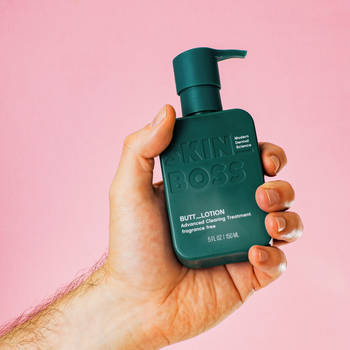
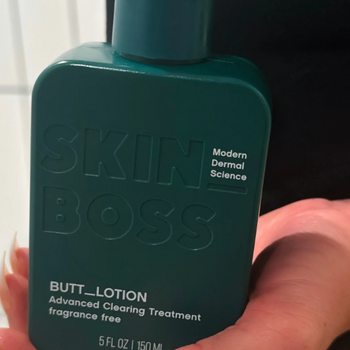
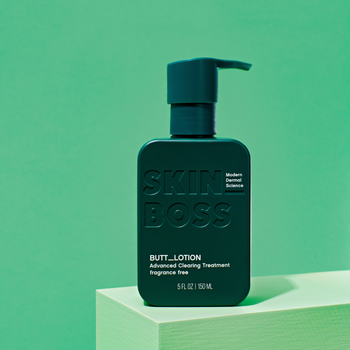
Sitting all day isn't magically creating acne, but constant pressure and friction can make already-problematic butt follicles harder to manage. SKINBOSS pairs THE LUXE LOOP™ as the gentle physical exfoliant with THE BUTT ACNE TREATMENT™ as the moisturizing chemical exfoliant with salicylic acid + Lactiv® Complex, while THE PEACH PATCH™ can protect an appropriate individual breakout. Reduce the mechanical trigger, clear follicular buildup and keep the barrier strong enough to handle the hours your butt inevitably spends in a chair.
References
- American Academy of Dermatology Association / Is sports equipment causing your acne? — https://www.aad.org/public/diseases/acne/causes/sports-equipment
- American Academy of Dermatology Association / Acne-like breakouts could be folliculitis — https://www.aad.org/public/diseases/a-z/folliculitis
- Mayo Clinic / Folliculitis: Symptoms and causes — https://www.mayoclinic.org/diseases-conditions/folliculitis/symptoms-causes/syc-20361634
SKINBOSS JOURNAL of MODERN DERMAL SCIENCE