Anese does not appear to be shut down as of August 2026. Its direct-to-consumer website is active and currently lists its signature That Booty Tho. body scrub for sale, although some older third-party retailer listings are no longer available.
So if you came here because you couldn't find the Anese product you used to buy somewhere else, the better question may not be “What happened to Anese?”
It may be:
What was that product actually doing for my skin, and what should I use if I want a different approach?
That is where the formulation gets interesting.
Did Anese Actually Shut Down?
Based on currently available public information, no clear evidence shows that Anese has shut down.
Its current website remains live and transactional. That Booty Tho. is listed directly by the brand, along with other body-care products.
What has changed is availability through some outside retailers.
An older Urban Outfitters listing for Anese Booty Glaze, for example, is now marked unavailable. That can easily make a brand look discontinued when someone searches for a product through the retailer where they originally discovered it.
Retail disappearance and company shutdown are not the same thing.
That distinction matters, especially in a comparison article.
Why Do People Think Anese Closed?
There are several plausible reasons without inventing a corporate story.
Products that were once available through major retailers are now unavailable on some of those sites.
Older Anese product assortments were broader than the assortment currently visible on its main site.
Brand domains and merchandising have also changed over time.
And consumers tend to interpret a missing product page as “the company disappeared.”
That is understandable.
It just isn't enough evidence to state that a company shut down.
Is That Booty Tho. Still Available?
Yes, currently.
Anese's direct website lists That Booty Tho. as its signature booty scrub.
The current standard size is listed at $32.
The formula is built around Juglans Regia (Walnut) Shell Powder as the physical exfoliating material, along with emollient and conditioning ingredients including Butyrospermum Parkii (Shea) Butter, Simmondsia Chinensis (Jojoba) Seed Oil and Rosa Canina Fruit Oil.
Anese directs consumers to massage the scrub over wet skin and use it multiple times per week.
That is a very specific treatment philosophy:
particulate physical exfoliation first and foremost.
What Did Anese Become Known For?
Anese was early to make butt skincare feel like an actual beauty category.
That contribution matters.
The brand brought playful names, bright packaging and products specifically positioned for the buttocks, hips and thighs into a beauty market that had historically acted as if everything below the neck needed one generic bottle of body lotion.
Their signature approach centered heavily on texture.
Scrubs.
Masks.
Serums.
Body-specific positioning.
That helped normalize the idea that people wanted targeted skincare for their butt.
The next question is whether a traditional body scrub is the best technical answer for every follicular bump.
Not necessarily.
Is Anese That Booty Tho. an Acne Treatment?
The current product is marketed primarily as a body scrub for smoother texture and contains walnut-shell particles for physical exfoliation.
That is different from a leave-on acne medication.
And it's different from a leave-on keratolytic lotion containing an active such as salicylic acid.
This distinction matters because “butt acne” itself is already an imprecise term.
A scrub can remove loose material from the skin surface.
But what if the problem is compacted keratin inside and around hundreds of follicles?
Now we need another mechanism.
What Is Actually Causing Butt Acne-Like Bumps?
This is where body skincare needs to move past the word acne.
Many butt bumps are not classic acne vulgaris.
They may represent:
- keratosis pilaris
- folliculitis
- ingrown hairs
- friction-related follicular inflammation
- acne mechanica
- true acne in some cases
Those conditions overlap visually.
They do not have identical biology.
KP, for example, is largely a follicular keratinization problem.
Folliculitis means inflammation of the hair follicle and may involve bacterial, fungal or physical triggers.
A shaving bump has a hair-growth component.
You cannot intelligently formulate for all of these by starting with “bumps = oil.”
Why Doesn't Face-Acne Logic Work Well on the Butt?
Because the buttocks are not simply a second face.
Classic facial acne is strongly associated with sebaceous activity.
The buttocks are much more commonly dealing with keratinized follicular buildup, friction, occlusion, hair removal, and follicular inflammation.
That changes treatment.
If the problem is not primarily excess sebum, stripping away oil has limited logic.
And it can leave the surrounding barrier dry enough that clothing friction becomes even more irritating.
The smarter body strategy is:
manage follicular buildup while supporting the barrier.
Those goals are not opposites.
Is a Physical Scrub Enough for Butt Bumps?
Sometimes physical exfoliation improves the texture immediately.
That part is real.
Remove loose corneocytes from a rough skin surface and it feels smoother.
But surface smoothness and follicular normalization are not exactly the same thing.
Imagine a KP-prone thigh.
Hundreds of follicles have compacted keratin around their openings.
A physical exfoliant can help remove loosened material from the surface.
Useful.
But chemical exfoliation can loosen keratin through a different mechanism.
That's why I don't see physical versus chemical exfoliation as an either/or decision.
For appropriate skin, they can complement one another.
What Is the Problem With Harsh Body Scrubs?
The issue is not the existence of physical exfoliation.
The issue is uncontrolled abrasion.
Particle abrasiveness depends on more than the ingredient name.
Particle shape matters.
Size matters.
Pressure matters.
How long you rub matters.
How much water is present matters.
And user technique varies enormously.
Someone who lightly massages a scrub for 20 seconds is performing a very different procedure from someone grinding the same product into one stubborn patch for three minutes.
That's why controlled physical exfoliation appeals to me more for chronic follicular skin.
Repeatability matters.
Is Walnut Shell Powder Too Harsh for Skin?
You cannot accurately declare an entire raw material universally “too harsh” without considering particle specification and finished formulation.
That would be bad cosmetic chemistry.
Walnut shell is a physical exfoliating particle, and Anese currently uses it in That Booty Tho.
The relevant question is whether the total exfoliation method and pressure suit the user's skin.
Someone with resilient, noninflamed body skin may tolerate a particulate scrub comfortably.
Someone with inflamed folliculitis, freshly shaved skin or an already compromised barrier may not.
Context wins.
What Is Better: A Scrub or a Chemical Exfoliating Lotion?
They do different jobs.
A physical exfoliant works through contact.
A chemical exfoliant uses chemistry to loosen keratinized buildup.
For recurring butt and thigh texture, I prefer thinking about the two mechanisms separately.
Physical exfoliation clears loose surface material.
Chemical exfoliation then continues managing keratin without requiring additional rubbing.
And if that chemical exfoliant sits inside a moisturizing lotion?
Now treatment and barrier support happen together.
That's much more interesting than simply asking which scrub has the biggest grit.
Does Salicylic Acid Help Butt Bumps?
It can.
Salicylic acid is a keratolytic chemical exfoliant that can help loosen accumulated cells and follicular buildup.
Its usefulness extends beyond oily facial skin.
This is an important distinction.
Using salicylic acid on KP-prone or follicular body skin does not mean we are treating the butt like an oily face.
The ingredient is being used for its keratolytic action.
Same molecule.
Different formulation logic.
Does Lactic Acid Help Butt Texture?
Yes.
Lactic acid is an alpha hydroxy acid and a particularly useful ingredient for rough body skin because exfoliation can be paired elegantly with moisturization.
That matters for KP-prone skin.
The goal should not be:
remove keratin,
dry the surface,
then rescue the barrier later.
A well-built body formulation can exfoliate while supporting skin hydration at the same time.
Treatment and moisturizer do not have to live in separate bottles.
What About Niacinamide?
Niacinamide is a useful supporting body-care ingredient.
It is especially interesting for barrier support and the appearance of uneven post-inflammatory pigmentation.
But I would not use niacinamide as the central answer to plugged follicles.
It performs a different role.
This is where marketing tends to flatten ingredient function.
Salicylic acid.
Lactic acid.
Niacinamide.
All useful.
Not interchangeable.
What Should You Use Instead of Anese for Butt Acne?
First, decide what you liked about the product.
If you loved the immediate polished feeling of a scrub, you are looking for physical exfoliation.
If you were trying to reduce recurring follicular bumps, you should also be thinking about chemical exfoliation.
If the skin feels dry after treatment, the barrier needs a better place in the routine.
Those needs suggest a system rather than a single aggressive product.
Physical exfoliation.
Then chemical exfoliation.
Then continued moisturization.
Or even better, chemical exfoliation delivered inside the moisturizer itself.
What Should You Use Instead for Keratosis Pilaris?
KP is where the difference becomes especially clear.
KP involves excess keratinized material accumulating around follicular openings.
That makes keratolytic ingredients particularly relevant.
Common approaches include:
lactic acid,
salicylic acid,
urea,
and retinoids.
Physical exfoliation can help remove loosened surface material.
But a rough scrub alone does not permanently change the follicle's tendency to plug.
KP is ongoing management.
Not something you scour out once.
What Should You Use Instead for Folliculitis?
First make sure you're actually dealing with folliculitis.
Folliculitis has several causes.
Bacterial.
Fungal.
Frictional.
Occlusive.
A physical exfoliant does not replace antimicrobial or antifungal treatment when one is medically indicated.
And an active inflamed pustular eruption is not the ideal time for vigorous scrubbing.
This is where product comparison stops being useful.
Diagnosis takes over.
If bumps are itchy, pustular, rapidly spreading, painful or recurrent despite basic care, see a dermatologist.
What Should You Use Instead for Ingrown Hairs?
Ingrown hairs need the follicular surface kept clear enough that regrowing hair can exit normally.
Chemical exfoliation can help manage keratinized buildup around the opening.
Gentle physical exfoliation may help loosen superficial debris.
But hair-removal technique matters too.
If the razor creates the problem every Thursday, adding four products on Friday is not the cleanest solution.
Change the razor variable.
Then support the follicle.
Should You Replace a Scrub With an Acid?
Not necessarily.
I would replace scrub-only thinking with a better exfoliation framework.
There are two useful categories:
physical exfoliation
and
chemical exfoliation.
One is not inherently primitive and the other inherently sophisticated.
What matters is how well controlled each method is.
A gentle physical exfoliant can improve the surface.
A leave-on chemical exfoliant can work on compacted keratin through chemistry.
Used intelligently, those approaches complement one another.
Should Physical Exfoliation Come First?
Yes, when both steps are part of the routine.
The sequence has logic.
Gentle physical exfoliation removes loose buildup from the surface.
Then the leave-on chemical exfoliant goes onto skin that has already been cleared of that unnecessary surface layer.
Physical first.
Chemical second.
Not because the order looks nice on a routine card.
Because they are performing two different jobs.
Should You Use a Scrub on Active Butt Pimples?
I would avoid aggressively rubbing over inflamed or open lesions.
Physical exfoliation is better thought of as field maintenance across intact skin.
It isn't pimple punishment.
If one lesion is swollen, painful or pustular, grinding particles across it does not make the treatment more targeted.
Sometimes the smartest exfoliation technique is avoiding the inflamed spot entirely.
What If You Loved Anese Because It Made Skin Feel Smooth Immediately?
That's the classic advantage of physical exfoliation.
You can feel the surface change immediately.
Chemical exfoliation often feels less theatrical.
There may be no dramatic polishing moment.
But over repeated use, it can address the keratinization process contributing to recurrent roughness.
Immediate sensorial payoff and longer-term follicular management are different benefits.
A sophisticated routine can have both.
What If You Used Anese for Dark Butt Marks?
First, treat the bumps creating the marks.
That's priority one.
Every new inflamed follicle is another opportunity for post-inflammatory hyperpigmentation.
Niacinamide and other tone-supportive ingredients can be useful.
Chemical exfoliation can improve surface turnover.
But if you are still picking, over-scrubbing and repeatedly inflaming the follicles, pigment treatment spends its life cleaning up after your routine.
Stop manufacturing new marks.
Then address the old ones.
Is a Body Scrub Bad for Hyperpigmentation?
Not automatically.
But irritation can worsen pigment problems, particularly in skin prone to post-inflammatory hyperpigmentation.
That means exfoliation intensity matters.
If the area becomes red, sore or inflamed after scrubbing, the exfoliation may be creating exactly the inflammatory signal you don't want.
The best pigmentation routine is frequently much less exciting than people hope.
Control the inflammation.
Protect the barrier.
Don't pick.
Wait.
Are Scrubs Bad for Sensitive Skin?
Some sensitive skin tolerates gentle physical exfoliation.
Some does not.
What I would avoid is equating visible redness with successful exfoliation.
Sensitive skin has a narrower irritation window.
If the skin burns when lotion goes on after the scrub, that's not an impressive deep clean.
That's feedback.
Use a gentler method.
Is a Leave-On Lotion Better for Sensitive Butt Skin?
Often.
A well-designed leave-on lotion can combine:
chemical exfoliation,
humectancy,
emollience,
and barrier support
without requiring aggressive physical abrasion.
That does not make all lotions gentle.
Formula still matters.
But from a design standpoint, treating and moisturizing simultaneously is an elegant fit for sensitive KP-prone or follicular body skin.
Can You Use Both Physical and Chemical Exfoliation Daily?
Potentially, if both methods are specifically gentle enough for that frequency and the skin tolerates them.
Daily does not automatically mean over-exfoliation.
Intensity matters.
A mild daily chemical exfoliating lotion and controlled physical exfoliation can be more tolerable than a concentrated weekly peel plus aggressive scrub.
Watch the barrier.
Burning.
Persistent redness.
Peeling.
Tenderness.
Those are signals to reduce treatment.
How Long Should a New Butt-Care Routine Take to Work?
Expect several weeks for recurring follicular texture and breakouts.
Immediate smoothness after physical exfoliation is not the same endpoint as fewer new follicular bumps.
For a new routine, look for:
less roughness,
fewer new inflamed follicles,
a more even surface,
and skin that remains comfortable.
If the only change after two weeks is that your butt feels increasingly dry, the routine needs work.
Is Anese Better for Texture Than Acne?
The current flagship Anese product is most directly formulated and marketed as a physical body scrub for smoother texture.
That's a fair description of what it does.
If your primary goal is the sensorial experience of scrubbing and immediate surface smoothness, that format may appeal to you.
If your primary goal is managing recurrent keratin plugging, KP-like texture or acne-like follicular bumps, I would also want chemical exfoliation and barrier support in the strategy.
Different goal.
Different architecture.
Is Anese Still Worth Buying?
That is ultimately a preference question.
Anese is currently operating and its signature scrub remains available directly from the brand.
If you like granular body scrubs and your skin tolerates one, its current product remains an option.
But if what you are searching for is a follicular treatment system rather than simply a scrub, compare mechanisms instead of brand aesthetics.
Ask:
Where is the physical exfoliation?
Where is the chemical exfoliation?
Where is the moisturization?
What exactly is addressing keratin buildup?
Those questions make product comparison much easier.
What Makes a Better Butt-Acne Routine?
A better routine treats the follicle without making the barrier collateral damage.
Start with controlled physical exfoliation.
Follow with chemical exfoliation appropriate to the skin concern.
Build moisturization into the routine.
Reduce friction.
Avoid picking.
And stop assuming every butt bump needs oil control just because facial acne does.
The body deserves more precise formulation than that.
THE SKINBOSS PERSPECTIVE
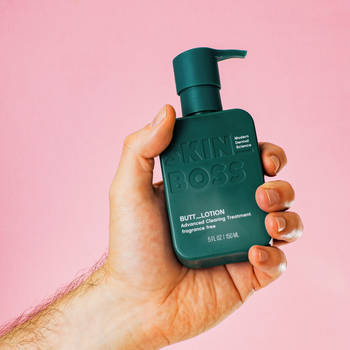
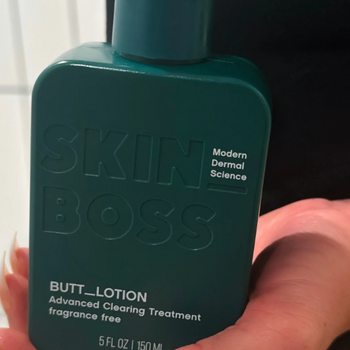
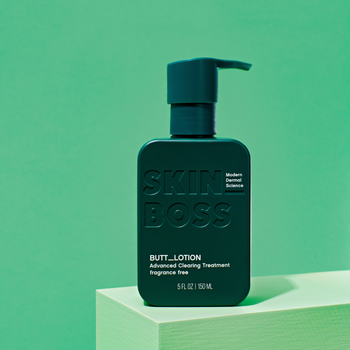
Anese helped make booty skincare a real category, and its current signature approach remains centered on a granular physical scrub. SKINBOSS takes the next step differently: THE LUXE LOOP™ provides controlled physical exfoliation first, followed by THE BUTT ACNE TREATMENT™ with salicylic acid + Lactiv® Complex for leave-on chemical exfoliation, moisturization and barrier support; THE PEACH PATCH™ can protect an appropriate individual bump from picking and friction. The difference isn't “scrub versus no scrub.” It's physical + chemical exfoliation working together without treating the butt like an oily face.
References
- Anese / That Booty Tho. product page — Anese product page
- Anese / Official website — Anese official website
- Urban Outfitters / Anese Booty Glaze Serum — Urban Outfitters archived retail listing
- American Academy of Dermatology Association / Keratosis pilaris: Diagnosis and treatment — AAD KP treatment guidance
- American Academy of Dermatology Association / Acne-like breakouts could be folliculitis — AAD folliculitis guidance
SKINBOSS JOURNAL of MODERN DERMAL SCIENCE