Yes, you can use retinol or another topical retinoid on buttock skin, and retinoids can help some conditions that people call “butt acne” by normalizing follicular cell turnover and reducing keratin plugging. But retinol is not automatically the best treatment for every butt bump because butt acne is often not acne vulgaris at all.
That's the part most retinol advice skips.
Before adding another active, identify the bump.
Your butt does not need a facial anti-aging routine just because it has follicles.
Does Retinol Actually Help Butt Acne?
Retinoids can help acne by preventing dead skin cells from accumulating inside follicles and can also be useful for keratosis pilaris.
AAD's current acne guidelines strongly recommend topical retinoids as an acne treatment, and dermatologists also use retinoids including adapalene, retinol, tretinoin and tazarotene for keratosis pilaris.
That sounds like a straightforward yes.
It isn't quite.
“Butt acne” is a consumer description, not a diagnosis. Bumps on the buttocks can represent KP, folliculitis, friction-related inflammation, ingrown hairs or true acne.
Retinoids make more sense for some of those than others.
What Does Retinol Do to a Clogged Hair Follicle?
Retinoids change how epidermal cells develop and shed.
For acne-prone follicles, that matters because abnormal accumulation of keratinized cells contributes to formation of the follicular plug.
Instead of treating only the bump you can see, a retinoid helps normalize the process that creates clogged follicles in the first place.
AAD describes topical retinoids such as adapalene, tretinoin, tazarotene and trifarotene as treatments that unclog pores and reduce inflammation.
That's why retinoids are legitimate acne medications.
But there's an important terminology problem.
Is Retinol the Same as a Retinoid?
Retinol is a retinoid, but not all retinoids are retinol.
“Retinoid” is the larger vitamin A-derived ingredient family.
Retinol is commonly found in over-the-counter cosmetic skincare. Acne treatment more often involves retinoids such as adapalene, tretinoin, tazarotene or trifarotene. Adapalene is also available without a prescription in the United States.
AAD specifically describes retinol as a type of retinoid used in over-the-counter products and identifies adapalene, tretinoin, tazarotene and trifarotene among retinoids used to treat acne.
So asking “does retinol treat butt acne?” and “do retinoids treat acne?” are slightly different questions.
The second has considerably stronger clinical footing.
Is Retinol Good for Keratosis Pilaris on the Butt?
It can be. Retinoids are among the keratolytic treatments dermatologists may recommend for keratosis pilaris.
KP is a particularly relevant distinction because adults can develop keratosis pilaris on the buttocks, and those little rough bumps are frequently mistaken for pimples.
With KP, excess keratin creates plugs around hair follicles.
No excess facial-style sebum problem is required.
That's why ingredients that address keratinization make sense.
AAD lists retinoids alongside alpha hydroxy acids, lactic acid, salicylic acid and urea as ingredients that may help diminish KP's bumpy texture.
This is one of the cases where retinol on the butt is completely rational.
Does Retinol Help Butt Folliculitis?
This is where the answer changes.
Retinol is not an antimicrobial treatment for bacterial or fungal folliculitis.
Folliculitis means inflammation of the hair follicle. Infection can be part of that picture.
A vitamin A derivative that changes keratinization does not suddenly become antibacterial because the folliculitis resembles acne.
If you have an abrupt outbreak of itchy, tender or pustular bumps, particularly after a hot tub, shaving or another obvious trigger, don't assume you simply need stronger exfoliation.
Mechanism first.
Product second.
Can Retinol Make Butt Folliculitis Worse?
It can certainly make irritated skin more irritated.
Retinoids commonly produce dryness, peeling and irritation, especially when first introduced. AAD recommends strategies such as using a smaller amount, decreasing frequency and incorporating moisturizer when retinoid irritation occurs.
If the skin is already inflamed from active folliculitis, piling an irritating retinoid onto it may complicate the picture.
That's not the moment I'd choose to conduct a maximalist active-ingredient experiment.
Let the active inflammatory problem be properly addressed.
Is Retinol Better Than Salicylic Acid for Butt Acne?
Neither ingredient is universally “better.” They work differently.
Retinoids normalize follicular cell turnover.
Salicylic acid is a keratolytic beta hydroxy acid used to help clear clogged follicles.
Both are recognized acne-treatment approaches. AAD's acne guidelines include recommendations for topical retinoids and salicylic acid.
For body skin, however, tolerability and formulation matter enormously.
A powerful active you use twice and abandon because your butt feels like sandpaper has not won the formulation contest.
Is Retinol Better Than Lactic Acid for Butt Bumps?
Again, different tools.
Lactic acid is an alpha hydroxy acid that helps loosen excess keratin at the skin surface while also having humectant properties.
Retinoids alter cellular differentiation and turnover.
For KP and rough follicular texture, both approaches can be reasonable. AAD specifically lists lactic acid and retinoids among options dermatologists use for KP.
But lactic acid has one interesting advantage for body-formulation design: it fits beautifully into moisturizing lotion systems.
And body skin with keratin buildup often needs exactly that combination.
Exfoliation plus barrier support.
Can Retinol Dry Out Your Butt?
Oh, yes.
Dryness is one of the predictable problems with retinoid use.
Peeling, redness and irritation can happen too.
And this matters more than people think because the instinct with “acne” is often to interpret dryness as evidence that the product is working.
It isn't.
Barrier damage is not an efficacy endpoint.
AAD specifically recommends moisturizer for people using retinoids and other drying acne treatments because moisturization can help skin tolerate them.
If your treatment leaves the surrounding skin raw, you've created another problem.
Why Does the Skin Barrier Matter for Butt Acne?
Because most butt bumps are not simply a story about excess oil.
That's the face-acne logic that gets copied onto the body without much thought.
True acne vulgaris involves sebum, follicular plugging and inflammation.
But the buttocks commonly develop KP, folliculitis, friction-related irritation and ingrown hairs.
A routine built entirely around stripping oil misses much of that biology.
For rough follicular body skin, the better question is often:
How do I normalize keratin buildup without destroying the surrounding barrier?
That's a formulation question.
And a much better one.
Can Retinol Help Dark Marks From Butt Acne?
Potentially.
Retinoids are used for uneven pigmentation as well as acne, and retinol is commonly used in cosmetic products targeting pigmentation and texture.
But don't confuse preventing and treating the original bumps with treating the marks they leave behind.
Post-inflammatory hyperpigmentation can persist after the follicle itself is calm.
And if your retinoid causes enough irritation to create new inflammation, you've managed to pursue discoloration by creating more of it.
Not ideal.
Control the bumps first.
Can Retinol Help Ingrown Hairs on the Butt?
It may help reduce the keratin buildup that contributes to follicular obstruction, but ingrown hairs also have a mechanical component.
A hair has been cut or removed and then grows back into or beneath the skin.
Shaving technique matters.
Hair characteristics matter.
Friction matters.
Exfoliation can be part of prevention, but don't treat every ingrown hair as retinoid deficiency.
Sometimes the razor is the more interesting suspect.
Can You Use Retinol After Shaving Your Butt?
I wouldn't introduce a strong retinoid immediately after shaving if your skin is prone to irritation.
Shaving has already physically stressed the stratum corneum and follicular openings.
Adding an irritating active directly afterward can sting spectacularly.
Separate the steps.
Let freshly shaved skin settle.
Then resume the treatment according to its directions and your tolerance.
More interventions in one evening do not make a better routine.
Can You Use Retinol After Waxing?
Same principle.
Waxing physically removes hair and stresses the surrounding skin.
Immediately following that with a retinoid can increase irritation.
Give the skin time to recover.
And if you're using prescription tretinoin, tazarotene or another potent retinoid, discuss hair-removal practices with your dermatologist because retinoid-treated skin can be more vulnerable to irritation and injury.
The butt doesn't get an exemption from basic retinoid care.
Can You Use Retinol and Salicylic Acid Together on the Butt?
You can encounter routines that contain both, but more exfoliating activity is not automatically better.
Retinoids and salicylic acid can each cause irritation.
If you're already using one effectively, adding another active should have a reason beyond “I own it.”
Introduce products gradually.
Pay attention to dryness, burning and persistent redness.
The barrier is giving you data.
Listen to it.
Can You Use Retinol and Lactic Acid Together?
Same caution.
Both can influence keratinization and skin turnover through different mechanisms.
Using them together or on alternating days may be tolerable for some people, but stacking multiple active exfoliating systems increases the potential for irritation.
For KP in particular, AAD explicitly warns that keratolytic treatments can make skin raw or irritated when they're overused.
You don't need to exfoliate your way into dermatitis.
Should You Physically Exfoliate If You Use Retinol?
If you use physical exfoliation, keep it genuinely gentle.
Retinoid-treated skin can already be dry and reactive.
Adding aggressive scrubs, stiff brushes or enthusiastic washcloth abrasion is a poor combination.
Physical exfoliation and chemical exfoliation can coexist.
But the physical step should remove loosened surface material without damaging the barrier.
If your skin is red afterward, that's not “deep exfoliation.”
That's irritation.
How Often Should You Use Retinol on Your Butt?
Follow the directions for the specific product.
There is no responsible universal frequency for every retinol, adapalene or prescription retinoid because potency, formulation and indication differ.
If irritation develops, frequency may need to decrease.
AAD specifically notes that dermatologists may recommend using retinoids less often when irritation occurs.
Start conservatively.
Consistency beats intensity.
Your follicles are not impressed by suffering.
Should You Use Retinol on Your Butt Every Night?
Not necessarily.
Some prescription regimens are intended for daily use.
A cosmetic retinol product may have different instructions.
Sensitive or dry skin may need slower introduction.
And if you're simultaneously using acids or other exfoliants, your total routine matters more than the frequency of one ingredient viewed in isolation.
Think in terms of total irritation load.
That's how a formulator thinks about it.
Should Retinol Go on Wet or Dry Skin?
Follow the product directions, but dry skin is the usual safer starting point for retinoids.
Applying an active to freshly washed, still-damp skin can increase how intensely some people experience it.
If irritation is already an issue, don't chase maximum penetration.
You are treating skin.
Not trying to win a permeability competition.
Should You Moisturize After Retinol?
Yes, if your skin needs it.
AAD specifically recommends moisturizer as part of acne care when treatments such as adapalene, tretinoin or tazarotene create dryness.
Moisturizer does not “cancel” the retinoid.
A well-supported barrier can make it easier to continue treatment consistently.
And consistent tolerable treatment usually beats heroic intermittent treatment.
How Long Does Retinol Take to Work on Butt Acne?
Give retinoid-based acne treatment weeks, not days.
AAD recommends giving an acne treatment about 6–8 weeks before judging early improvement rather than constantly switching products.
KP is even more explicitly a maintenance condition.
AAD notes that KP treatment can take four to six weeks to show improvement and requires ongoing maintenance because treatment doesn't permanently cure the condition.
Take progress photos if you need objectivity.
Daily butt inspection is not a scientifically rigorous endpoint.
Can Retinol Permanently Cure Butt Acne?
No topical ingredient deserves that promise.
If the bumps are true acne, retinoids can help control acne while treatment continues.
If the bumps are KP, treatment manages the condition rather than permanently curing it.
If they're bacterial folliculitis, retinol isn't treating the primary cause at all.
This is why diagnosis-by-product-name is backwards.
Figure out the process.
Then choose the active.
Can You Use Retinol on the Butt During Pregnancy?
Topical retinoids and retinol should be avoided during pregnancy unless your healthcare professional specifically advises otherwise.
AAD advises pregnant patients to avoid prescription retinoids and over-the-counter retinol-containing products. It also notes that most experts recommend stopping adapalene and tretinoin during pregnancy.
If you're pregnant, trying to become pregnant or breastfeeding, discuss your body-acne routine with your OB/GYN or dermatologist.
Don't assume that “it's only going on my butt” changes the recommendation.
What Can You Use Instead of Retinol During Pregnancy?
This is a conversation for your OB/GYN or dermatologist because ingredient choice, concentration and extent of use matter.
AAD notes that azelaic acid is thought to be safe during pregnancy and that limited use of benzoyl peroxide or salicylic acid may sometimes be considered after discussing it with a physician.
Pregnancy is not the time to crowdsource a maximalist body-acne routine.
Have the five-minute conversation.
Who Should Skip Retinol on the Butt?
I'd be cautious if the skin is already:
very dry,
raw,
sunburned,
freshly waxed,
actively inflamed,
or covered in a suspected infectious folliculitis.
People taking oral isotretinoin also need particularly gentle skincare. AAD specifically advises avoiding topical retinol and exfoliating AHAs/BHAs during isotretinoin treatment because of increased irritation and skin sensitivity.
And pregnancy gets its own hard stop.
What Is Better Than Retinol for Butt Acne?
That depends entirely on what you're calling butt acne.
For true acne vulgaris, a retinoid can be an excellent evidence-based treatment.
For KP and rough keratin-plugged follicles, lactic acid, salicylic acid, retinoids and urea are all established keratolytic approaches.
For infectious folliculitis, identify and address the infection.
For friction-related bumps, change the friction.
There is no single “best butt-acne ingredient” because there is no single butt-acne disease.
That's the answer worth remembering.
THE SKINBOSS PERSPECTIVE
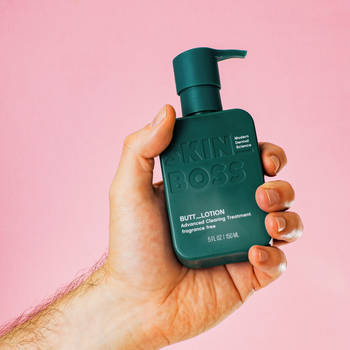
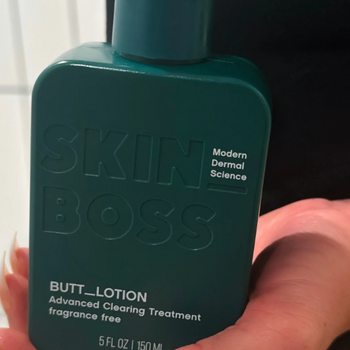
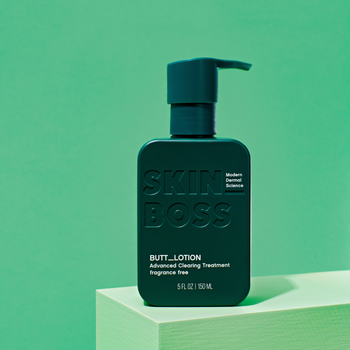
Retinol isn't wrong for butt skin. It's simply not automatically the smartest first answer to every butt bump. SKINBOSS takes a barrier-first follicular approach: THE LUXE LOOP™ provides controlled physical exfoliation, followed by THE BUTT ACNE TREATMENT™ with salicylic acid + Lactiv® Complex for leave-on chemical exfoliation, moisturization and ongoing keratin management. Face-acne logic says dry the breakout harder; Modern Dermal Science asks what's happening inside the follicle first, then treats it without sacrificing the surrounding barrier.
References
- American Academy of Dermatology Association / Acne clinical guideline — AAD acne guideline
- American Academy of Dermatology Association / Keratosis pilaris: Diagnosis and treatment — AAD KP treatment guidance
- American Academy of Dermatology Association / Keratosis pilaris: Self-care — AAD KP self-care guidance
- American Academy of Dermatology Association / Retinoid or retinol? — AAD retinoid and retinol guidance
- American Academy of Dermatology Association / Acne: Diagnosis and treatment — AAD acne treatment guidance
- American Academy of Dermatology Association / Is any acne treatment safe to use during pregnancy? — AAD pregnancy acne guidance
- American Academy of Dermatology Association / Dermatologist-approved pregnancy skin care — AAD pregnancy skincare guidance
SKINBOSS JOURNAL of MODERN DERMAL SCIENCE