The best body lotion for bacne is a non-comedogenic moisturizer that supports the skin barrier without adding unnecessary pore-clogging potential. If the back is also rough or follicularly congested, a lotion containing an exfoliating ingredient such as salicylic acid can do two jobs at once: moisturize the skin and help keep follicles clearer.
Skipping moisturizer altogether is not the sophisticated acne strategy people think it is.
Sometimes it's exactly what makes the routine harder to tolerate.
Should You Use Body Lotion If You Have Back Acne?
Yes.
Having bacne does not mean your back should be kept as dry as possible.
Dermatologists frequently recommend moisturizer as part of an acne routine because common acne actives, including salicylic acid, benzoyl peroxide and retinoids, can disrupt the barrier enough to cause dryness, peeling and irritation. A moisturizer can improve tolerability, which matters because acne treatment only works when you can use it consistently.
This is one of skincare's strangest lingering myths.
Acne looks oily.
Therefore, moisturizer must be bad.
But skin hydration and surface oil production are not interchangeable concepts.
Your stratum corneum still needs water and a functional lipid barrier even if follicles are acne-prone.
You don't make acne healthier by making the surrounding skin miserable.
What Kind of Lotion Is Best for Bacne?
Look for a body lotion labeled non-comedogenic, non-acnegenic, oil-free or “won't clog pores,” especially if you know your back develops true acne.
AAD specifically recommends acne-friendly skin-care products with these descriptions for back acne and acne-prone skin.
Then look beyond the front label.
The formula still needs to suit what your skin is doing.
If your back is oily and acne-prone, you may prefer a lightweight lotion or gel-lotion.
If acne treatment has made your back dry and tight, you may need more emollience.
If the skin has rough follicular texture alongside pimples, an exfoliating lotion may make more sense than a plain moisturizer.
“Best lotion” is not one texture for every back.
Formulation has context.
What Does Non-Comedogenic Actually Mean?
Non-comedogenic means a product is formulated or positioned as unlikely to clog pores and promote comedones.
It does not mean “physically incapable of ever causing a breakout in any human.”
That distinction matters.
Skin is individual.
Finished formulas matter.
Application amount matters.
Other products in the routine matter.
And comedogenicity itself is not perfectly predicted by looking at one ingredient in isolation.
I am not a fan of internet lists that declare every ester, butter or fatty material either permanently “safe” or “pore clogging” regardless of concentration and formulation.
Cosmetics do not work ingredient-by-ingredient in a vacuum.
The finished product is the relevant unit.
Does Oil-Free Automatically Mean a Lotion Won't Clog Pores?
No.
“Oil-free” and “non-comedogenic” are related consumer cues, but they are not technically identical.
An oil-free formula can still be poorly suited to your skin.
And a formula containing certain emollient lipids isn't automatically destined to create acne.
This is why I care more about the whole product than the morality assigned to an ingredient category.
AAD recommends oil-free and non-comedogenic products for acne-prone back skin because they reduce unnecessary pore-clogging risk. That's useful guidance.
Just don't translate it into:
“All oils are evil.”
Formulators stopped thinking that simplistically a long time ago.
What Ingredients Should a Bacne Lotion Have?
For acne-prone back skin, I look for a formula that does at least two things well:
supports the barrier and manages follicular buildup.
That may include humectants to bind water.
Emollients to improve flexibility.
And, where appropriate, a chemical exfoliant to address the follicle itself.
For bacne, salicylic acid is particularly relevant because it helps unclog pores and is widely used in acne care.
For rough body texture or overlapping keratin buildup, AHAs can also be useful.
But the concentration printed on the bottle isn't the entire formulation.
pH.
Vehicle.
Application frequency.
Skin tolerance.
All of those change how the product behaves.
Is Salicylic Acid Good in a Body Lotion for Bacne?
Yes.
Salicylic acid is one of the most logical ingredients for an acne-prone body lotion because it chemically exfoliates and helps keep follicles from remaining clogged.
AAD includes salicylic acid among established acne ingredients and specifically recommends acne treatment alongside acne-friendly skin care.
What I especially like about salicylic acid in a leave-on body format is the opportunity to treat an entire acne-prone field rather than chasing one pimple at a time.
That's useful on a back.
You may have fifty follicles heading toward congestion before five of them become visible.
Area treatment makes sense.
Spot treatment alone is often too late to the party.
Is Lactic Acid Good for Bacne?
Lactic acid can be useful when roughness, dry keratin buildup and uneven body texture coexist with breakouts.
It's an alpha hydroxy acid.
Its primary exfoliating action is different from salicylic acid, and it can be formulated beautifully into moisturizing lotion systems.
That last part matters.
Back skin does not need a philosophical choice between “treatment” and “moisturizer.”
A chemist can build both functions into one product.
Especially on body skin, that can dramatically simplify adherence.
And simple routines tend to get used.
Is Benzoyl Peroxide Better Than a Bacne Lotion?
They solve different jobs.
Benzoyl peroxide is an established treatment for inflammatory acne, while a moisturizer or exfoliating lotion helps support the barrier and may manage follicular buildup depending on its actives.
AAD specifically recommends benzoyl peroxide washes for mild to moderate back acne and notes that a 5.3% wash may produce less dryness and irritation than stronger OTC concentrations.
So this is not:
benzoyl peroxide versus moisturizer.
A well-designed routine may involve both.
For example, someone with inflammatory bacne might use an appropriate benzoyl peroxide wash and follow with a non-comedogenic leave-on lotion.
One addresses acne bacteria and inflammation.
The other helps maintain the skin environment and treatment tolerability.
Different jobs.
Why Does My Back Get Dry If I Have Acne?
Because acne and dryness can coexist quite happily.
Actually, unhappily.
Your back may naturally be oily in some areas and still become dehydrated or irritated from treatment.
Benzoyl peroxide can dry it.
Salicylic acid can dry it.
Retinoids can certainly dry it.
Then add hot showers and aggressive cleansing.
Now you have acne plus barrier disruption.
AAD specifically recommends moisturizer when acne medications make the skin dry and irritated.
Dryness is not evidence that you've successfully defeated acne.
Sometimes it's evidence that you overdid the routine.
Can Dry Skin Actually Make Bacne Look Worse?
Absolutely.
Dry skin can become rough and flaky, making every follicle look more obvious.
Irritation can add redness.
Then people interpret the new texture as more clogged pores and exfoliate even harder.
That's the wrong feedback loop.
You want acne treatment working inside or around the follicle without creating a second condition across the skin surface.
Barrier support keeps the treatment environment more stable.
That matters over six weeks.
And twelve weeks.
Not just the ten minutes after you shower.
Should Bacne Lotion Be Lightweight?
Often, yes.
A lightweight lotion or gel-lotion can be more comfortable across acne-prone back skin, especially in warm weather or after workouts.
But lightweight should not become another meaningless beauty rule.
Some acne-prone backs are genuinely dry.
Some tolerate a cream beautifully.
Some hate anything richer than a fluid emulsion.
AAD recommends matching moisturizer texture to skin needs while still looking for non-comedogenic labeling in acne-prone skin.
The formulation should disappear comfortably enough that you will use it.
If it feels like you've laminated your back, you're probably not reaching for it tomorrow.
Are Thick Body Butters Bad for Bacne?
They can be less ideal for some acne-prone backs, particularly if the product is highly occlusive and applied heavily.
But I wouldn't make the category itself illegal.
A body butter isn't a diagnosis.
A person with very dry skin may tolerate a richer product perfectly well.
A person with active comedonal bacne may prefer something lighter and specifically non-comedogenic.
This is where formulation literacy beats internet ingredient panic.
Ask how the skin responds.
Not whether the jar looks rich.
What Ingredients Clog Back Pores?
There is no universally reliable ingredient blacklist that predicts every person's bacne.
That's the answer people hate.
They want twelve ingredients to avoid forever.
Skin does not cooperate.
Some raw materials have historically shown higher comedogenic potential under specific testing conditions, but the comedogenicity of a finished cosmetic cannot always be inferred from the presence of one ingredient.
Concentration changes behavior.
Interactions change behavior.
Vehicle changes behavior.
So rather than interrogating every fatty alcohol like a criminal suspect, start with a finished product intended for acne-prone skin.
Then watch your actual back.
Are Fatty Alcohols Pore Clogging?
Not automatically.
This misconception deserves its own section.
Fatty alcohols such as cetyl alcohol and cetearyl alcohol are not the same thing as drying alcohols such as ethanol.
Fatty alcohols are often used as emollients, consistency agents and structural components in emulsions.
They can help make a lotion stable and pleasant.
Seeing “alcohol” in the INCI does not mean the product is an astringent.
And seeing cetearyl alcohol does not mean the formula is inherently comedogenic.
Ingredient names require context.
That's formulation 101.
Should You Avoid All Oils If You Have Bacne?
No.
You should avoid products that consistently aggravate your acne and favor formulas designed for acne-prone skin.
That's different.
Certain oily hair and skin products can contribute to clogged pores on acne-prone areas, which is why dermatologists advise looking for non-comedogenic or oil-free products.
But “oil” is a chemical category far too broad to predict finished-product behavior from the word alone.
Different lipids have different structures.
Different spreading characteristics.
Different oxidation profiles.
Different concentrations.
Cosmetic chemistry has more than one variable.
Can Hair Conditioner Cause Bacne?
Yes, hair products can contribute to back breakouts in some people.
Think about the shower sequence.
Conditioner goes into the hair.
You rinse it.
It travels directly down your upper back.
Then maybe a leave-in product touches the same area for the next eight hours.
If you are breakout-prone, rinse hair products thoroughly and cleanse the back afterward rather than assuming your body lotion is the culprit.
This is one of those tiny routine changes that costs nothing.
And occasionally fixes a mystery.
Can Body Lotion Cause Bacne Even If It Says Non-Comedogenic?
Yes, an individual can still react poorly to a product.
Non-comedogenic reduces concern. It doesn't constitute a personal guarantee.
You might react to fragrance.
The texture might be too occlusive for your routine.
You may be layering it over another product.
Or the acne flare may have nothing to do with the lotion at all.
This is why I like changing one variable at a time.
Otherwise you replace your moisturizer, cleanser, laundry detergent and sports bra simultaneously and learn absolutely nothing.
Skincare science occasionally requires patience.
Rude, but true.
Should You Apply Lotion to Wet or Dry Back Skin?
For basic moisturization, slightly damp skin can help retain water.
AAD recommends applying moisturizer after washing because it helps trap water in the skin.
But medicated or exfoliating lotions may have specific directions.
Follow them.
An acid-containing leave-on treatment may be intended for fully dry skin to optimize consistency and tolerability.
“Apply everything to damp skin” is not a universal law.
Product directions exist for a reason.
Should You Put Lotion on Bacne Every Day?
If your skin tolerates the formula and it is designed for daily use, daily application often makes sense.
Especially if you're using acne treatments that dry the skin.
Consistency matters far more than occasional heroic treatment.
The skin barrier needs ongoing support.
Follicular congestion also develops over time.
A lotion applied twice because your back looks bad before vacation isn't much of a routine.
The bottle is not ornamental.
Can You Use Face Moisturizer on Your Back?
Technically, yes.
Economically?
Your wallet may have opinions.
A face moisturizer can be perfectly appropriate if it is non-comedogenic and your back likes it.
But body skin covers a much larger surface area.
That is why a well-formulated body product usually makes more sense.
You need enough slip for distribution.
Enough play time to spread it across the back.
Enough value that applying the correct quantity doesn't feel financially irresponsible.
Formulation format follows use area.
Is Bacne the Same as Butt Acne?
No, and this is an important brand-level distinction.
The back is a more classically sebaceous acne site than the buttocks.
True acne vulgaris is common on the back because the area has substantial pilosebaceous activity.
That means face-acne mechanisms transfer to the back more readily than they do to many “butt acne” bumps.
The butt is more often dealing with folliculitis, KP, ingrowns and friction-related issues.
So I would not say all body acne isn't sebum-related.
That would be too broad.
Modern Dermal Science means being accurate enough to let different body sites actually be different.
Why Is Bacne Harder to Treat Than Face Acne?
Partly because it's harder to reach.
This sounds almost comically obvious until you formulate the routine.
You can see your face.
You can reach your face.
Applying a leave-on treatment evenly between your shoulder blades is another project entirely.
AAD actually recommends using a lotion applicator for back medication when necessary.
The skin on the back is also thicker than facial skin, and the area spends more time beneath clothing.
Then there is sweat.
Backpacks.
Sports bras.
Hair products.
Your back has logistics.
Does Friction Make Bacne Worse?
Yes.
Backpacks, tight clothing and athletic equipment can create pressure and repetitive rubbing over acne-prone skin.
AAD recommends avoiding items that repeatedly rub against back acne because friction can trigger flares.
This is where skincare products reach their limit.
You can formulate a beautiful acne lotion.
It cannot negotiate with a backpack strap scraping the same shoulder for six hours.
Sometimes changing the mechanical trigger is part of treatment.
Does Sweating Make Bacne Worse?
Sweat itself is not dirty.
But prolonged dampness beneath clothing can contribute to an environment where acne and follicular irritation become harder to manage.
AAD recommends changing out of sweaty clothing and showering as soon as reasonably possible after exercise for people with back acne.
So work out.
Sweat.
Live your life.
Just don't marinate in the shirt afterward.
Should You Exfoliate Bacne?
Yes, appropriately.
Chemical exfoliation is useful for follicular congestion, while gentle physical exfoliation can help remove loose surface buildup.
The important word is gentle.
AAD specifically warns against abrasive scrubs, loofahs, back brushes and buff puffs for back acne because scrubbing can worsen irritation and acne.
This doesn't make all physical exfoliation inherently bad.
It means uncontrolled abrasion is bad.
A physical exfoliant should remove loosened surface material without turning the back red.
Chemical exfoliation works differently, using acids to help loosen keratinized cells.
Two mechanisms.
Neither requires punishment.
Can You Use an Exfoliating Lotion and Benzoyl Peroxide Together?
Potentially, but tolerance matters.
A benzoyl peroxide wash plus a leave-on exfoliating lotion may be appropriate for some acne-prone backs.
Others will become irritated.
Start with a sensible routine rather than assembling every effective acne ingredient into a chemistry gauntlet.
Benzoyl peroxide.
Salicylic acid.
AHA.
Retinoid.
All at once.
Congratulations, you invented dermatitis.
More actives are not automatically more efficacy.
What About Niacinamide in a Bacne Lotion?
Niacinamide can be useful in a formula designed to support the barrier and reduce the appearance of redness or uneven tone.
I like it as a supporting ingredient.
But I wouldn't choose a bacne lotion because “niacinamide” is printed in large letters on the front.
For active acne, I care more about whether the formula contains an appropriately selected acne or exfoliating active and whether the overall vehicle is acne-friendly.
Supporting ingredients are supporting ingredients.
They do not need starring roles.
Is Fragrance-Free Better for Bacne-Prone Skin?
Not because fragrance clogs pores.
That's the wrong mechanism.
But fragrance-free can be useful when skin is already irritated or sensitive from acne treatment, because eliminating unnecessary potential irritants simplifies the formula.
AAD specifically recommends gentle, fragrance-free skin care for back acne.
This distinction matters.
“Fragrance causes bacne” is too broad.
“Fragrance may add irritation to already reactive treatment-exposed skin” is much more defensible.
Precision is cooler anyway.
How Long Does a Bacne Lotion Take to Work?
If the lotion contains an active targeting follicular congestion, think in weeks.
AAD notes that acne improvement typically takes around 6–8 weeks, and complete back-acne clearing can take 3–4 months.
That doesn't mean nothing happens until day 42.
You may notice smoother texture earlier.
Fewer new lesions may be the first sign.
Existing inflammation may start resolving.
But judge the pattern, not one pimple.
Acne treatment is preventive as much as reactive.
How Do You Know If Your Bacne Lotion Is Clogging Your Pores?
Look for a repeatable pattern.
Did the new breakouts begin after you introduced the lotion?
Are they appearing across the exact application area?
Do they diminish when the product is removed while the rest of the routine stays stable?
That's useful evidence.
One random pimple two days after starting a moisturizer is not enough.
Acne lesions do not appear instantaneously after every causal event.
Give causality a little respect.
What If Bacne Lotion Makes Your Skin Sting?
Persistent stinging is not a success metric.
If a chemical exfoliating lotion produces mild transient sensation and the directions anticipate it, that may be tolerable.
But burning, escalating redness, peeling or discomfort means the routine needs attention.
Reduce frequency.
Review the other actives you're using.
And stop if the skin becomes significantly irritated.
The formula you can use consistently will outperform the one you're afraid to apply.
When Should You See a Dermatologist for Bacne?
See a dermatologist if the acne is deep, painful, nodular, cystic, scarring or not improving after a consistent OTC routine.
AAD specifically recommends medical treatment for deep or painful back acne and notes that ordinary back-acne treatment should start showing results after about six to eight weeks.
Also reconsider the diagnosis if the bumps are highly uniform and itchy.
That can suggest folliculitis rather than ordinary acne.
A stronger lotion is not the cure for a wrong diagnosis.
What's the Best Overall Routine for Bacne-Prone Skin?
Keep it rational.
Shower after sweating.
Use a gentle cleanser.
If appropriate, use an acne-active wash such as benzoyl peroxide.
Don't scrub.
Reduce friction from bags and clothing.
Use a leave-on chemical exfoliant if follicular congestion is part of the problem.
Then moisturize with an acne-friendly formula that supports the barrier.
That last step isn't optional because acne skin somehow doesn't deserve moisturizer.
Quite the opposite.
The best bacne routine treats the follicle and keeps the skin comfortable enough to stay on the routine.
THE SKINBOSS PERSPECTIVE
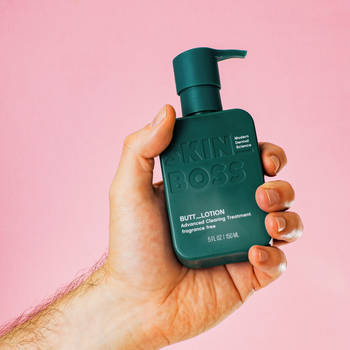
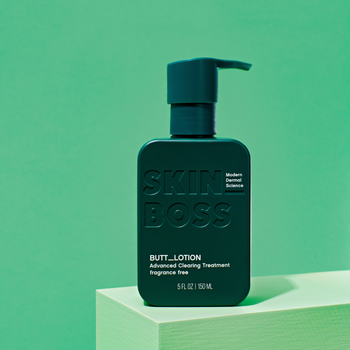
The smartest bacne lotion isn't simply “oil-free.” It should help keep follicles clear without making the surrounding skin pay for the treatment. SKINBOSS pairs THE LUXE LOOP™ for controlled physical exfoliation with THE BUTT ACNE TREATMENT™ with salicylic acid + Lactiv® Complex for moisturizing chemical exfoliation, and that same physical + chemical framework can be used on appropriate intact back and body skin. Treat the follicle, moisturize the barrier and leave the sandpaper scrub out of it.
References
- American Academy of Dermatology Association / Back acne: How to see clearer skin — https://www.aad.org/public/diseases/acne/DIY/back-acne
- American Academy of Dermatology Association / Moisturizer: Why you may need it if you have acne — https://www.aad.org/public/diseases/acne/skin-care/moisturizer
- American Academy of Dermatology Association / Acne: Diagnosis and treatment — https://www.aad.org/public/diseases/acne/derm-treat/treat
- American Academy of Dermatology Association / 10 skin care habits that can worsen acne — https://www.aad.org/public/diseases/acne/skin-care/habits-stop
- American Academy of Dermatology Association / How to pick the right moisturizer for your skin — https://www.aad.org/public/everyday-care/skin-care-basics/dry/pick-moisturizer
SKINBOSS JOURNAL of MODERN DERMAL SCIENCE