Most buttne myths start with the same mistake: assuming every bump on the butt is acne and treating it like an oily face. Harsh scrubbing, drying the skin, squeezing bumps and endlessly switching spot treatments can irritate the barrier without fixing follicular buildup, keratosis pilaris, ingrown hairs or folliculitis.
The smarter question isn't “what kills butt acne?”
It's what is this bump?
Myth #1: Buttne Is Just Acne on Your Butt
No. “Buttne” is a consumer term, not a diagnosis.
The buttocks can develop true acne, but plenty of acne-looking bumps there are something else entirely.
Folliculitis involves inflammation of the hair follicle and can have bacterial, fungal or noninfectious causes.
Keratosis pilaris is a keratinization problem. Excess keratin collects around follicular openings and produces small, rough bumps that people often mistake for pimples.
Ingrown hairs can create inflamed papules after shaving.
Then you have irritation from pressure, friction and occlusion.
So when somebody says, “I tried everything for my butt acne,” one of my first thoughts is: did you actually have acne?
That question changes everything downstream.
Myth #2: You Need to Scrub Buttne Off
No. You cannot scrub a follicular disorder out of the skin.
This may be my least favorite buttne advice because it feels so logical.
The skin feels bumpy, so people assume something is physically stuck on top. Then they grab salt scrub, sugar scrub, coffee grounds, a rough mitt or the harshest washcloth in the house and go to work.
But a follicular plug isn't sitting on the butt like dried paint.
Keratin can accumulate within and around the follicular opening. Inflammation may already be present. Repeatedly rubbing that skin harder does not fix the biology underneath.
Dermatologists specifically advise gentle exfoliation for KP and recommend stopping or reducing exfoliating treatments if skin becomes irritated.
Physical exfoliation can absolutely have a place in body care.
Aggression does not.
The goal is controlled removal of loosened surface cells, not friction until the butt turns pink.
Myth #3: If It Stings, It's Working
Absolutely not.
Stinging tells you that sensory nerves are being stimulated. It does not tell you that follicular congestion is clearing.
This is one of skincare's stranger psychological traps.
A product tingles. The consumer thinks: there it is. That's the active working.
Maybe.
Or your barrier hates it.
Acids, alcohol-heavy formulas and other acne treatments can cause irritation. Persistent burning, redness, scaling or tight shiny skin are not achievement badges.
A body product can be effective without announcing itself every time you apply it.
As a formulator, tolerability matters enormously because body concerns are rarely solved with one heroic application. They require consistency.
The formula someone can actually use wins.
Myth #4: Drying Out the Skin Dries Out Butt Acne
This is where face-acne thinking creates trouble.
Many acne-like butt bumps are not driven by excess sebum, so stripping oil from the area may do very little except damage the barrier.
True acne involves the pilosebaceous unit, including sebum.
KP doesn't.
An ingrown hair isn't an oil problem either.
And folliculitis has several possible causes that cannot be reduced to “too much oil.”
Yet acne care spent decades teaching consumers that dry = clean = clear.
So somebody sees butt bumps and reaches for an aggressive cleanser, an astringent, a drying treatment and no moisturizer whatsoever.
Now the original bumps are still there and the entire butt is flaky.
Not progress.
Myth #5: Moisturizer Will Make Buttne Worse
Moisturizing does not automatically clog follicles, and barrier support can be particularly useful when exfoliating ingredients are part of the routine.
Dermatologists routinely recommend moisturizers alongside acne treatments because ingredients such as salicylic acid and benzoyl peroxide can dry or irritate skin.
Moisturization is even more integral to keratosis pilaris care.
Why?
Because dry, compacted keratin and rough follicular texture often coexist. A keratolytic moisturizer can help exfoliate while simultaneously improving hydration.
That combination makes far more sense than exfoliate, dry out, exfoliate harder, repeat.
Look at the finished formula rather than treating the word lotion like a warning label.
Myth #6: Buttne Means You're Dirty
No.
And this one needs to die.
Folliculitis, keratosis pilaris, ingrown hairs and acne are not proof of poor personal hygiene.
Can hygiene habits affect the follicular environment? Of course.
Sitting around for hours in damp workout clothes isn't ideal. Reusing dirty workout gear isn't something I'd recommend either.
But a person can shower every day and still have KP.
They can have folliculitis.
They can shave carefully and still develop ingrown hairs.
Overwashing because you think the condition means you're dirty can create another problem: irritation.
Clean skin is useful.
Punishing skin is not cleaner.
Myth #7: Sweat Causes Buttne
Sweat is not a universal cause of buttne.
Sweat can contribute to an environment where friction, prolonged moisture and occlusion aggravate follicular skin, but sweating by itself doesn't explain every breakout.
Think about a workout.
Your leggings are tight. The skin is warm. Fabric repeatedly moves against the same area. Then you drive home and stay in those clothes while answering email.
That environment can aggravate follicular problems.
The practical solution isn't “never sweat.”
Change out of damp clothes. Shower when you can. Reduce unnecessary friction.
Your sweat glands aren't plotting against you.
Myth #8: Tight Leggings Always Cause Butt Acne
Not exactly.
Tight clothing can aggravate follicular problems through friction, pressure, heat and trapped moisture, but leggings aren't a universal cause of buttne.
If you have the same bumps regardless of what you're wearing, clothing probably isn't the whole story.
But if you consistently break out under one tight seam or after spending four hours in sweaty compression leggings, that's useful information.
Skin patterns are data.
I'd pay attention to that before buying your seventh acid serum.
Myth #9: Benzoyl Peroxide Is the Answer for Every Butt Bump
Benzoyl peroxide is a legitimate acne ingredient. It is not a universal butt-bump ingredient.
For true inflammatory acne, benzoyl peroxide has well-established utility.
But remember what we're dealing with.
KP is not acne.
An ingrown hair is not acne.
And folliculitis has different causes. Some folliculitis may involve bacteria, but other forms may involve yeast or noninfectious follicular inflammation.
So using benzoyl peroxide on every bump because “bacteria cause acne” is an oversimplification.
Match the ingredient to the condition.
That's modern skincare.
Myth #10: Salicylic Acid Is Only for Oily Facial Skin
No. Salicylic acid is useful beyond an oily T-zone because it is a chemical exfoliant that can help address follicular congestion.
That's particularly relevant to body skin.
On the buttocks, salicylic acid may make sense in a treatment designed around rough follicular buildup, clogged follicles and acne-like bumps.
But I still care about how it's formulated.
Salicylic acid in a harsh, drying base and salicylic acid in a moisturizing body lotion are not interchangeable simply because the active name matches.
Vehicle matters.
The whole formula always matters.
Myth #11: The Strongest Acid Percentage Works Fastest
No.
This is formulation marketing pretending to be math.
Higher active concentration can increase activity, but it can also increase irritation. The most effective concentration is one that provides meaningful activity in a formula the skin can tolerate consistently.
You can't judge an acid product by percentage alone.
pH affects acid behavior. Vehicle affects delivery. The combination of exfoliants matters. Contact time matters. Skin condition matters.
And irritating your skin enough that you need to stop treatment for two weeks isn't a shortcut.
It's downtime.
I would rather see steady exfoliation than chemical bravado.
Myth #12: You Need to Exfoliate as Hard as Possible
You need appropriate physical and chemical exfoliation, not maximum exfoliation.
They are different tools.
A physical exfoliant removes loosened cells through contact with the surface.
A chemical exfoliant uses ingredients such as salicylic acid or AHAs to help release compacted cells chemically.
That pairing is useful because rough follicular body skin exists at more than one level.
But there is a ceiling.
If you physically exfoliate aggressively, use multiple acids, add a retinoid and then wonder why your butt burns against your underwear, the problem is no longer insufficient exfoliation.
You built yourself a barrier problem.
Myth #13: Picking a Butt Pimple Makes It Heal Faster
It usually makes the situation messier.
Squeezing or picking adds physical trauma to an already inflamed follicle and can increase the chance of prolonged discoloration or scarring.
And buttock skin has one practical disadvantage.
You sit on it.
So after you've squeezed the bump, you put clothing over freshly traumatized skin and apply pressure to it for hours.
Leave it alone.
The five seconds of satisfaction isn't worth turning one bump into a month-long dark mark.
Myth #14: Every Red Bump Is Folliculitis
Also no.
Folliculitis has become internet skincare's replacement diagnosis for butt acne.
That isn't much better.
Folliculitis specifically means inflammation of a hair follicle, but red buttock bumps can also represent KP, ingrown hairs, irritation, acne and other dermatologic conditions.
And folliculitis itself isn't one disease with one cause.
That is why persistent pustules, spreading inflammation or recurrent outbreaks deserve evaluation rather than endless product experimentation.
A label only helps when it's the right label.
Myth #15: Keratosis Pilaris Can Be Permanently Cured
No. Keratosis pilaris can be managed, but treatment doesn't permanently erase the underlying tendency toward follicular keratin buildup.
This distinction matters because people often find something that works, stop using it completely and then assume the treatment “failed” when the bumps return.
KP is maintenance skincare.
Dermatologists recommend moisturization and keratolytic ingredients such as lactic acid, salicylic acid or urea to improve the bumps.
If you discontinue everything and the texture gradually returns, that's not unusual.
Management isn't failure.
It's how chronic skin tendencies work.
Myth #16: You Should Skip Lotion Until the Breakouts Clear
That can be exactly backward.
If your treatment routine is drying or exfoliating the skin, withholding moisturizer may make the routine harder to tolerate without addressing the actual cause of the bumps.
Barrier support is part of smart treatment.
This is especially obvious when the butt is simultaneously bumpy and dry.
The skin doesn't need you to choose between “clear” and “moisturized.”
A good formulation can work on follicular buildup while improving the surrounding skin.
That's the point.
Myth #17: A Face Acne Routine Should Work Exactly the Same on Your Butt
No, because the condition may not be the same.
True facial acne is a disease of the pilosebaceous unit. Many bumps consumers call buttne are follicular conditions that aren't being driven primarily by excess sebum.
This is the central mistake behind a lot of failed butt care.
People take their face routine south.
Foaming acne cleanser. Drying toner. Strong spot treatment. No lotion.
But the butt may be dealing with keratin buildup, shaving irritation or folliculitis instead of sebaceous acne.
The location changed.
So did the biology.
Treat body skin like body skin.
Myth #18: One Spot Treatment Can Fix an Entire Field of Bumpy Skin
Not if the problem involves hundreds of follicles.
Spot treatments make sense for a spot. Field conditions require field treatment.
If you have one inflamed bump, treat the bump appropriately.
If both buttocks have uniform follicular roughness, dotting salicylic acid onto 46 individual bumps is missing the obvious.
Treat the skin area.
This is particularly relevant for KP and widespread follicular congestion, where the issue isn't one rogue follicle. It is the pattern of keratinization across an entire region.
Sometimes the delivery format tells you whether the treatment logic makes sense.
Myth #19: If Nothing Has Worked in a Week, Switch Products
No.
Follicular skin changes on a biological timeline, not a weekend timeline.
Individual inflamed bumps can change quickly. Overall texture and chronic follicular buildup take longer.
Constantly switching products creates another problem: you never know what helped, what irritated you or whether anything had enough time to work.
Choose a sensible routine.
Use it consistently.
Watch what the skin actually does.
Skincare needs fewer panic pivots.
Myth #20: Every Butt Bump Belongs in the Beauty Aisle
Definitely not.
Deep, painful, recurrent or draining lesions need medical evaluation, especially if they scar or occur repeatedly around the buttocks, groin or skin folds.
Hidradenitis suppurativa can produce deep, painful acne-like nodules and abscesses in areas where skin rubs together.
Widespread or persistent folliculitis may require treatment based on its specific cause.
This isn't the moment to buy a rougher scrub.
A good skincare expert should know where cosmetic care ends.
So What Actually Works for Buttne?
First, stop treating “buttne” as one disease.
Identify the likely pattern. Reduce obvious triggers such as shaving irritation or prolonged damp clothing. Support the barrier. Use gentle physical exfoliation where surface buildup is present and an appropriate chemical exfoliant when follicular keratin and congestion are part of the problem.
Then stay consistent.
The breakthrough usually isn't finding something harsh enough.
It's finally treating the correct mechanism without irritating the skin around it.
Hot people exfoliate.
They don't wage war on their butt.
THE SKINBOSS PERSPECTIVE
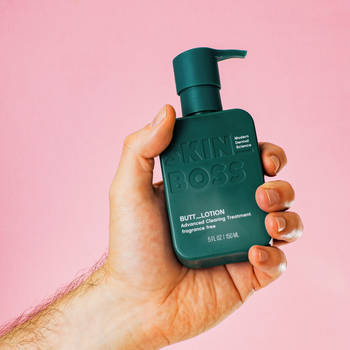
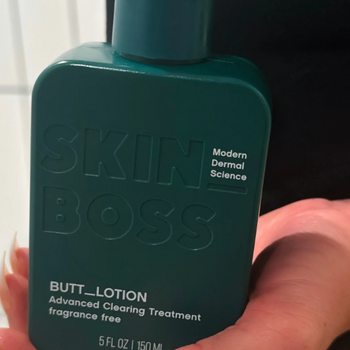
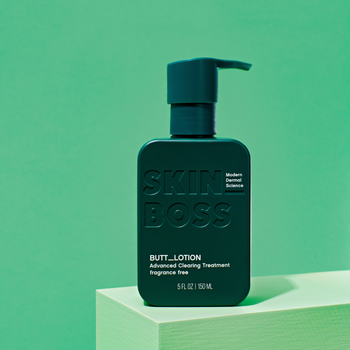
Most buttne routines fail because they start with “kill the acne” instead of asking what's happening at the follicle. SKINBOSS pairs THE LUXE LOOP™ as the gentle physical exfoliant with THE BUTT ACNE TREATMENT™ as the moisturizing chemical exfoliant with salicylic acid + Lactiv® Complex, while THE PEACH PATCH™ is the treatment for an appropriate individual breakout. Clear follicular buildup, support the barrier and save the aggression for something other than your skin.
References
- American Academy of Dermatology Association / Keratosis pilaris: Self-care — https://www.aad.org/public/diseases/a-z/keratosis-pilaris-self-care
- American Academy of Dermatology Association / Keratosis pilaris: Diagnosis and treatment — https://www.aad.org/public/diseases/a-z/keratosis-pilaris-treatment
- American Academy of Dermatology Association / Moisturizer: Why you may need it if you have acne — https://www.aad.org/public/diseases/acne/skin-care/moisturizer
- American Academy of Dermatology Association / Acne: Diagnosis and treatment — https://www.aad.org/public/diseases/acne/derm-treat/treat
- American Academy of Dermatology Association / Adult acne treatment dermatologists recommend — https://www.aad.org/public/diseases/acne/diy/adult-acne-treatment
- Mayo Clinic / Folliculitis: Symptoms and causes — https://www.mayoclinic.org/diseases-conditions/folliculitis/symptoms-causes/syc-20361634
SKINBOSS JOURNAL of MODERN DERMAL SCIENCE