The best products for body acne on the back and bum depend on what is actually happening inside the follicle. Salicylic acid is useful for follicular congestion, benzoyl peroxide is an established treatment for true inflammatory acne, and moisturizing chemical exfoliants can be particularly useful for rough, keratin-heavy bumps on the bum. The mistake is assuming every body bump needs the same acne product.
Your back and your bum are only a few inches apart. Biologically, though, they are not interchangeable.
Is Back Acne the Same as Bum Acne?
No. Back acne can be true acne vulgaris, while many bumps people call “bum acne” aren't technically acne at all.
The upper back contains plenty of sebaceous glands. True acne develops when sebum and dead skin cells contribute to follicular plugging, followed by inflammation and other changes inside the pilosebaceous unit. Blackheads, whiteheads, inflammatory papules, pustules and deeper lesions can all occur on the back.
The buttocks are trickier.
Bumps there may represent folliculitis, keratosis pilaris, irritated follicles, ingrown hairs or true acne. Sweat and occlusion can complicate the picture further.
This is why I don't love treating “body acne” as one giant diagnosis.
Location matters.
If you have obvious blackheads and whiteheads across an oily upper back, acne logic makes sense. If you have dozens of tiny rough bumps scattered across otherwise dry buttock skin, I start thinking about follicular keratinization very differently.
And if the bumps itch?
That changes the conversation again.
What Causes Acne on the Back?
True back acne develops through the same basic acne mechanisms seen on the face: abnormal follicular plugging, sebum, inflammation and microbial activity within the follicle.
The back also creates a practical problem. Skin there is relatively thick, difficult to reach and routinely trapped under clothing.
Then add exercise.
A sweaty shirt stays pressed against the upper back for an hour. A sports bra rubs the same area repeatedly. A backpack sits directly over already inflamed follicles.
None of those things means poor hygiene caused your acne. They can, however, aggravate acne-prone skin.
The American Academy of Dermatology specifically recommends showering and changing clothes as soon as possible after sweating, cleansing gently rather than scrubbing and minimizing things that repeatedly rub against acne-prone back skin.
That last part is routinely ignored. People see back acne and reach for a brush.
Please don't scrub inflamed acne with a back brush.
Why Do I Get Acne-Like Bumps on My Bum?
Because the buttocks contain thousands of hair follicles, and several different follicular conditions can produce a pimple-like bump.
One common possibility is folliculitis, which literally means inflammation of the hair follicle. Folliculitis can be associated with bacteria, yeast, physical irritation and other causes. It may appear as clusters of small bumps or pustules centered around follicles.
Another possibility is keratosis pilaris. In KP, excess dead skin cells and keratin accumulate around follicular openings, producing tiny rough plugs. People frequently mistake these for pimples.
This distinction isn't academic.
If a bump is being driven primarily by abnormal keratin buildup, endlessly attacking it with oil-removing products misses the point. If you have infectious folliculitis, a cosmetic exfoliating lotion isn't a substitute for appropriate medical treatment.
And if you have true acne? Then acne treatments have a role.
Same-looking bump. Different biology.
What Is the Best Ingredient for Back Acne?
For true back acne, benzoyl peroxide has some of the strongest over-the-counter acne-treatment logic, particularly for inflammatory lesions.
The American Academy of Dermatology recommends benzoyl peroxide as an OTC option for mild to moderate back acne and notes that short-contact benzoyl peroxide washes can be useful on the back. Their back-acne guidance recommends allowing the wash to remain on the skin for roughly two to five minutes before rinsing.
That contact time matters. Immediately washing an active ingredient down the drain gives it very little opportunity to do its job.
Benzoyl peroxide has another characteristic everyone learns eventually: it can bleach fabric.
White towels become your friend.
Salicylic acid is also useful, especially where clogged pores and follicular buildup are prominent. It is a beta hydroxy acid that helps exfoliate and unclog pores rather than functioning simply as a surface scrub.
Which is better?
For obviously inflamed true acne, benzoyl peroxide has a compelling role. For congestion and follicular buildup, salicylic acid makes sense. Some acne routines use ingredients with different mechanisms rather than expecting one active to do everything.
What Is the Best Ingredient for Bum Acne?
For the buttocks, salicylic acid and alpha hydroxy acids such as lactic acid are particularly useful when the problem includes rough follicular buildup, KP-like texture or clogged follicles.
This is where body treatment starts separating itself from classic facial acne care.
Lactic acid chemically exfoliates compacted surface cells. Salicylic acid helps address follicular congestion. And a properly formulated lotion can deliver that exfoliation while simultaneously moisturizing the surrounding skin.
That last piece is not cosmetic fluff.
If the bum is dry and rough, repeatedly stripping it does not make the skin more functional. You want normalization of excess keratin without destroying the barrier around every follicle in the process.
For KP specifically, dermatologists recommend keratolytic ingredients including lactic acid and salicylic acid along with moisturization.
The best body treatment should make you less dependent on aggressive scrubbing, not give you a reason to scrub harder.
Is Salicylic Acid Good for Back and Bum Acne?
Yes, but for slightly different reasons depending on the condition.
On acne-prone back skin, salicylic acid helps unclog pores and exfoliate within the follicular environment. It is an established OTC acne ingredient.
On the bum, salicylic acid can be useful when the problem involves follicular congestion and excess keratin. This makes it relevant even when a person's so-called “bum acne” is not behaving exactly like facial acne.
That versatility is why salicylic acid appears in so many body-breakout products.
But concentration alone does not tell you whether a formula is good.
The vehicle matters. Contact time matters. The other exfoliating ingredients matter. How irritating the finished formula is matters.
As a formulator, I care a lot more about whether someone can use a treatment consistently than whether the front label has the most aggressive percentage on the shelf.
Is Lactic Acid Good for Body Acne?
Lactic acid can be excellent for rough, follicular body skin, especially when keratin buildup and dryness coexist.
It is an alpha hydroxy acid, but thinking of it simply as “another acid” undersells why it is useful on the body.
Body skin often needs exfoliation and moisturization simultaneously.
Lactic-acid-based formulas can help loosen compacted surface keratin while being formulated in a moisturizing vehicle. That makes them particularly interesting for KP-prone areas and rough buttock skin.
If I have a person with dry, bumpy buttock skin who has been scrubbing aggressively three times a week, my first instinct is not “find a stronger scrub.”
It's usually the opposite.
Stop traumatizing the skin and get the keratinization under control.
Does Benzoyl Peroxide Work for Bum Acne?
Benzoyl peroxide may help if the bumps are actually acne or an appropriate type of bacterial follicular eruption, but not every bum bump needs benzoyl peroxide.
This is an area where internet advice becomes sloppy.
Folliculitis has multiple causes. Bacteria are one possibility. Yeast is another. Physical damage to follicles can contribute. Mayo Clinic notes that folliculitis can have bacterial, fungal and other causes.
So “bum bumps = bacteria = benzoyl peroxide” is not a diagnosis.
If you have recurrent pustules, significant itching, spreading redness or bumps that don't respond to reasonable self-care, see a dermatologist. A clinician may need to determine whether you're treating acne, bacterial folliculitis, yeast-associated folliculitis or something else entirely.
Products work much better after the diagnosis makes sense.
Why Doesn't Face Acne Skincare Always Work on the Body?
Because true back acne and acne-like buttock bumps don't necessarily share the same biology, and body skin has different formulation demands.
Here is the nuance that often gets lost.
True acne on the upper back absolutely can involve sebum. The back contains many sebaceous glands, just like other acne-prone areas. So it would be inaccurate to say oil never matters in body acne.
But extend that logic to every bump on the buttocks and things fall apart quickly.
KP is not an excess-sebum disease. Many cases of folliculitis are not caused by excess oil either. Irritated follicles after shaving are not fixed by “mattifying” the bum.
Yet consumers routinely carry their facial-acne routine straight down the body: aggressive degreasing cleanser, drying treatment, no moisturizer.
Then the skin becomes tight, flaky and irritated.
A compromised barrier is not a victory.
Modern body skincare should be precise enough to ask what the follicle needs rather than treating every bump as an oily pore.
Should You Moisturize Body Acne?
Yes. Acne treatment and barrier support are not mutually exclusive.
This matters particularly on the bum and other dry, rough body areas.
A moisturizer can contain humectants that help bind water, emollients that improve flexibility and chemical exfoliants that address abnormal surface buildup. A well-designed active lotion is doing more than putting grease over a bump.
The finished formulation matters here.
Two products can both contain salicylic acid and behave completely differently on skin because one is a drying liquid and the other is built as a moisturizing treatment.
If your body treatment leaves the skin burning, shiny-tight and peeling continuously, don't confuse irritation with efficacy.
Skin can be exfoliated without being punished.
Is Physical or Chemical Exfoliation Better for Body Acne?
They do different jobs, and gentle physical exfoliation can complement chemical exfoliation when follicular surface buildup is part of the problem.
Physical exfoliation removes loose material from the skin surface through contact.
Chemical exfoliation uses ingredients such as salicylic acid or AHAs to loosen compacted cells and address follicular buildup chemically.
The word gentle is doing a lot of work here.
There is a substantial difference between lightly removing loosened surface buildup and scrubbing inflamed skin with coarse particles until it turns red. The latter creates irritation and can further compromise an already stressed barrier.
Dermatology guidance for both acne and KP specifically warns against aggressive scrubbing.
More friction is not more exfoliation.
Should You Exfoliate Before Applying a Body-Acne Treatment?
If you use a physical exfoliant, gentle physical exfoliation in the shower before applying a leave-on chemical exfoliant is a logical sequence.
You remove loose surface buildup first. Then the leave-on treatment goes onto clean, dry skin where it can remain in contact with the area.
Don't turn this into a twelve-step body routine.
Light physical exfoliation. Rinse. Dry the skin. Apply the leave-on treatment.
For inflamed acne on the back, however, don't aggressively physically exfoliate individual active lesions. There is nothing productive about repeatedly rubbing an inflamed pustule.
The routine needs to respond to the skin in front of you.
Can Sweat Cause Back and Bum Acne?
Sweat itself is not the entire cause of acne, but the environment created by sweating, occlusion and friction can aggravate acne and follicular conditions.
Think about what happens after a workout.
Sweaty fabric remains pressed against the back and buttocks. Tight leggings keep the area warm and occluded. A sports bra repeatedly rubs the upper back. Then someone drives home for 45 minutes in the same clothes.
Changing promptly and showering after heavy sweating is one of the least glamorous body-skin recommendations I can give you.
It also makes sense.
For back acne specifically, dermatologists recommend showering and changing clothes as soon as possible after exercise.
You don't need a $90 serum to fix a sweaty sports bra sitting on your skin for three hours.
How Long Do Body-Acne Products Take to Work?
For true back acne, six to eight weeks is a reasonable point to evaluate whether an OTC routine is producing meaningful improvement.
The American Academy of Dermatology notes that back-acne treatment may begin producing results in six to eight weeks, with more complete clearing taking longer.
Keratosis pilaris is different.
KP is a chronic tendency toward follicular plugging. Treatment can improve its appearance and texture, but it isn't something you “cure” with one bottle and never think about again. Maintenance matters.
That difference is another reason identifying the condition is so useful.
A pustule and a keratin plug should not have identical expectations.
When Should You See a Dermatologist for Back or Bum Acne?
See a dermatologist if you have deep painful lesions, recurrent boils, significant scarring, rapidly spreading redness, persistent pustules or breakouts that aren't improving with appropriate OTC care.
Deep nodules on the back deserve attention because truncal acne can scar.
And recurrent painful bumps around the buttocks, groin or areas where skin rubs against skin should not automatically be dismissed as “bad body acne.” Hidradenitis suppurativa can produce acne-like nodules in these areas and requires medical diagnosis and treatment.
Folliculitis also deserves medical evaluation when it is widespread, recurrent or not improving.
Knowing when skincare has reached the edge of its job is part of good skincare advice.
What Is the Best Routine for Back and Bum Breakouts?
The best routine is surprisingly simple: cleanse appropriately, use gentle physical exfoliation where rough follicular buildup is present, apply the correct chemical treatment, moisturize rather than strip the skin, and treat isolated lesions without picking them.
For true inflammatory back acne, that treatment may include an established acne active such as benzoyl peroxide.
For rough, congested buttock skin, chemical exfoliation with ingredients such as salicylic acid and lactic acid may make more sense.
If you have both?
Treat the areas according to their biology rather than demanding that one bottle solve every bump from your shoulders to your thighs.
That is what body skincare should have been doing all along.
THE SKINBOSS PERSPECTIVE
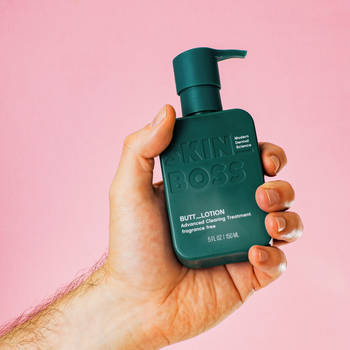
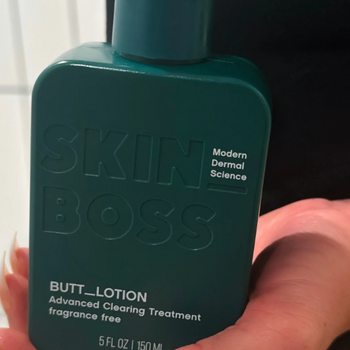
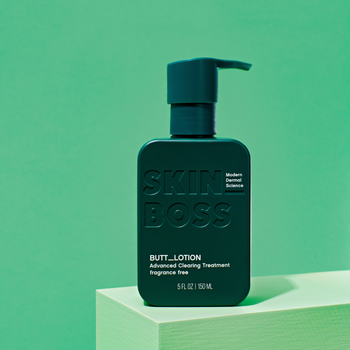
Back acne can be true acne; what gets called “bum acne” is often a more complicated follicular problem. SKINBOSS approaches body skin with THE LUXE LOOP™ as the gentle physical exfoliant, followed by THE BUTT ACNE TREATMENT™ with salicylic acid + Lactiv® Complex as the chemical exfoliant and moisturizing treatment, while THE PEACH PATCH™ handles an appropriate individual breakout. The point isn't to strip body skin until it feels squeaky clean. Clear the buildup, treat the follicle, support the barrier.
References
- American Academy of Dermatology Association / Back acne: How to see clearer skin — https://www.aad.org/public/diseases/acne/diy/back-acne
- American Academy of Dermatology Association / Acne clinical guideline — https://www.aad.org/member/clinical-quality/guidelines/acne
- American Academy of Dermatology Association / Adult acne treatment dermatologists recommend — https://www.aad.org/public/diseases/acne/diy/adult-acne-treatment
- American Academy of Dermatology Association / Keratosis pilaris: Self-care — https://www.aad.org/public/diseases/a-z/keratosis-pilaris-self-care
- American Academy of Dermatology Association / Keratosis pilaris: Who gets and causes — https://www.aad.org/public/diseases/a-z/keratosis-pilaris-causes
- American Academy of Dermatology Association / Is that stubborn acne really acne? — https://www.aad.org/public/diseases/acne/really-acne/stubborn-acne
- Mayo Clinic / Acne: Symptoms and causes — https://www.mayoclinic.org/diseases-conditions/acne/symptoms-causes/syc-20368047
- Mayo Clinic / Folliculitis: Symptoms and causes — https://www.mayoclinic.org/diseases-conditions/folliculitis/symptoms-causes/syc-20361634
SKINBOSS JOURNAL of MODERN DERMAL SCIENCE